skip to main |
skip to sidebar
August 15-16, 2009
I have decided to take this three-day weekend easy and travel with a small group back to Klosterneuburg. Father Clemens was so kind as to take time out of his day on Saturday to show us the Imperial Treasury. This is quite an honor because not everyone gets to have a tour of the two rooms that hold the treasures of the church. There are graduate and PhD students that have been denied access to the treasury, so it makes us all feel pretty special just to be able to enter.
There are many different treasures at Klosterneuburg that are known the world over. They have one of the only full sets of Jugendstil style vestments in the world, which is an Austrian style of Art Nouveau. The decorative patterns are ornate and heavy, and Father Clemens frequently questioned why they were being displayed upright rather than flat. I think it is interesting that popular Otto Wagner's artistic style of the day were becoming popular in the church as well.


This is a picture of the abbey's Nativity Scene, which depicts the birth of Jesus as described by Matthew and Luke. This Nativity is still used today in the church for the major holidays.

This is the skull of St Leopold. Enough said.

The Archducal Crown of Austria still resides in Klosterneuburg, as well as a papal excommunication if one should remove the crown for a given period of time.


These relics are posted for Kathy.


After the tour Father Clemens and joined us again at the wine garden, although it was a lot more tame this time. He brought with him a man in his Novitiate named Michael, who I ended up talking to most of the night. The Novitiate is a period of training that one must go through within a religious order before they take their vows. Michael hails from southern California so it was interesting to hear his perspective on American and European politics. I enjoyed hearing about his political views and we talked about everything from Obama to immigration to abortion. Table talk at its finest!
The next day Jan, Harrison, Caralee and myself decided to go to Sunday Mass, which was being performed by Father Clemens. I had a limited idea of what was going on, since the service was in German. I sat next to Jan and she very quietly translated the service for me. This is slightly ironic, but I have now been to Stift Klosterneuburg more times that I have been to church in America. Hmmm...

After the service we went with Father Clemens and Michael to get coffee. It was interesting because as we were in conversation, Father Elias decided to join us. I think that everyone in the coffee shop was wondering why the American tourists were so important! It turns out that Father Elias is from the United States as well and has been at Klosterneuburg about as long as Father Clemens. For me it was an amazing experience to be able to have such candid talk with so many important people within the church. They broke down barriers that I never knew existed within myself. By talking and joking with them it allowed me to respect their beliefs and place in the church yet at the same time see them as "normal" human beings.
August 14th, 2009
The German word of the day is dei der, which translates to "at your place."
The Enlightenment. This blog could be the longest one yet, but I am going to hold back!
The Enlightenment is a broad term used to describe a time in history (the eighteenth century) when people aspired toward freedom for individual thought and reason. Liberty, individual and natural rights, reason and logical reasoning were introduced during this time period. This new way of thinking was spread in places like coffee shops and salons; places where the church and the state did not have a hold. It created a divide within the Hopsburgs between those who embraced old school tradition and those who ushered in the new age.
In France and England the Enlightenment took hold through a "bottom-up process", meaning it was the work of peasants rather than the aristocrats who spread the ideas. Freemasonic lodges took hold that encompassed the ideals of "liberty, equality and fraternity". In many German-speaking countries the process of Enlightenment was more "top-down", meaning starting with the monarchy. Maria Theresa was an enlightened thinker in the fact that she thought more of the state than traditional dynastic terms. She founded multiple academies for military and academic purposes, promoted financial reforms through agriculture and helped to build a stronger Austria. At the same time as this was going on, however, she expelled the Jews from Bohemia and Prague. With the death of her husband, her son Joseph II became co-ruler and took up more enlightened ideals than his mother. There was bickering for some time between the two co-regents (Joseph didn't agree with his mothers disproval of religious toleration), but when she died he changed the governmental system within his empire. Joseph II practiced a term of enlightened despotism within his territories, supported mass education, secularized churches, abolished serfdom and did anything for the state that was within "reason". He was the product of an age of enlightenment.
The great composer Wolfgang Amadeus Mozart is a later product of enlightenment ideals. He was mentioned in class because of our trip to the opera later in the evening. Mozart was the 7th (and last) child born to his parents, and only one of two to survive. He was a musical prodigy who started composing by the age of five and performing at seven. After he gained fame and notoriety his goal was to raise music to a fine art form, which at the time it was not. Music was not seen as a tangible good, like painting or sculpting. He began his career in Salzburg and ended up in Wien after being dismissed from the court. His greatest successes were in his last years in Wien and include Don Giovanni, The Marriage of Figaro and The Magic Flute. He died poor in a common grave, but steadily grew in popularity after his death. Below is the monument to Mozart in the Wien Central Cemetery.
 The class went on an excursion to the opera Don Giovanni tonight, which ended up being incredibly entertaining! I have always wanted to attend an opera because I like to watch people in their fancy gowns and nice suits. The modern interpretation of the play was interesting because it was easy to understand and more relatable to the culture today. The voices were incredible and the acting was superb. There were some major differences in the updated version that I think actually made the story better. Instead of everything happening in one day the story is spread out over a lifetime. Don Giovanni and his crew age after his encounter with the statue (which is now a head), and I think he was haunted by Don Pedro. This is somehow more believable for me. I liked how everything was set at a modern hotel in Wien, and I especially liked the last scene before intermission. This scene was strange because it was "supposed" to be Don Giovanni escaping from his captors but in the modern play it was staged like some drug infused chaotic mess. For my first opera I thoroughly enjoyed it and I would definitely go back to another!


I have to mention the end of the night because it was go random! One of Kathy's friends, "The Original" Lady Gaga, "kidnapped" us and brought is to her bar for free drinks and appetizers. In our opera clothes we went to a Romanian bar filled with techno music and cigarette smoke. IT WAS AWESOME! Lady Gaga was super friendly and wanted to thank Kathy for giving her a free ticket. She gave all of us her e-mail address and told me, at the end of the night, "to take in Wien with an open heart."


August 13th, 2009
Students on the trip were very "tired" the day that we left the Alps, so that made it interesting considering we had an action packed day in store for us! Burg Liechtenstein is a castle in southern Austria that is right on the edge of Vienna's forest (Wienerwald). Unfortunately the castle was closed for repairs, like everything else in Vienna. It seems that all of Austria is in a constant state of repair, although I was definitely impressed by what I saw! This is the first castle that I have ever been close to so it was strange to think about the people that would have lived behind the walls in the 12th century. The castle was actually severely damaged during the Turkish sieges and was not rebuilt until 1884.


The Seegrotte tour was a really interesting tour and connects with the Nazi history that will be learning about later on the trip. The group traveled to Hinterbrühl, which is a small town in lower Austria. The tour guide said that The Seegrotte is a system of caves that includes Europe's largest underground lake. According to Wikipedia, "During the Second World War, a satellite camp of Mauthausen concentration camp was opened inside the caverns, producing parts for the He 162 jet fighter."

The lake formed after a mining accident in which a water line through a mountain was hit, flooding the cave. I'm sure that there were a lot of casualties that took place in the mine which is why I also find it rather interesting that Disney decided to later film the movie The Three Musketeers down there. That fact, to me, is rather creepy. We also found out after the tour that a couple of years back one of the boats that we were riding in flipped over and killed some tourists. On a better note the cave is very beautiful and I love the way that the reflection off of the water mirrors the interior of the cavern.


August 11-13, 2009
The Alps have been absolutely amazing over the last couple of days. Today has been one of the most relaxing days so far and also one of the most enlightening.

After a breakfast of ham, cheese and coffee I heard rumors of fellow students wanting to hike to Heukuppe, the summit of the Rax Mountain, which we are staying on. (I am now kicking my butt that I didn’t grab the extra jacket that my mom tried to give to me before I left!) I wanted to get up today with the small group that left to watch the sunrise at Ottohaus, a small bed and breakfast close to where we are staying, but I soon realized that I did not bring proper dress for the trip. This is unfortunate not only because I can’t go with the group, but also because it means I need to better take the advice of my mother.
At 9:45 AM I took off with Melodie, Natalie and Jan for a hike towards Ottohaus to see what we could find. The Austrian greenery is gorgeous!, with purple, yellow, white and orange flowers covering the surrounding hills. It was nice to be out of the busy city life and back into fresh air and a sense of freedom. We stopped at a few alters along the way to Ottohaus and Jan said that there are still people that will make pilgrimages to the sacred sites. The girls and I decided to "put on our hiking boots" and climb the difficult way up to Jakobskogel, a giant cross that overlooks Austrian valley. There are a lot of these crosses that can be seen from various mountaintops throughout the Alps and they date back to a time when Christianity reverted to nature and to marveling at the wondrous things that God can create. I imagine myself on the hike making my own pilgrimage, although I'm not quite sure what the end goal is supposed to be. It feels like I am at the top of the world on that mountain.

After we climbed back to Ottohaus and I had an AMAZING lunch of chocolate and a radler beer (great hiking nourishment!) the group hiked into an alpine garden towards a rock face that had been cut open manually. There was another cross that I had wanted to hike to but it started raining and I didn't want to fall of the rock face. The rain came and went the entire day, it couldn't really make up its mind whether to rain or be sunny. Jan and I took that chance that it would stay sunny (and it did!) and we went hiking together further up the mountain.

This time is probably what I enjoyed the most because we could relax at our own pace and talk about all sorts of different things. Jan was in many ways my saving grace on the trip because I feel like I related to her on more levels than some students who just wanted to party all the time. She is working on her PhD so it was nice to be able to "pick her brain" about not only school but life in general. The further up the mountain we hiked it seemed like the prettier the scenery became. Before we knew it we reached a sign that said "Ottohaus 1hr", and it only seemed like we had been walking for 20 minutes. By the time we got home it was already 5PM, so we had been hiking for roughly seven hours!

I think that is part of the point that Kathy was trying to make by brining us to the Alps. She was showing us how Austrians spend their free time away from the city and in nature. Many of the people who live in Vienna live in apartment buildings and complexes, so getting away to nature is important. There was a plethora of age groups and skill levels hiking in the mountains and in many ways I wish that Americans could be more in touch with nature and fitness. I would love to go back to the Alps during the winter and do some snow skiing. Apparently Jan trained to be a ski instructor in Switzerland, so maybe I can take some cues from her!
August 11th, 2009
The German word of the day for Aug. 10 was Autobhan, which translated into freeway.
We are on the way to the Austrian Alps right now, but not without making a stop first in Einstadt (aka Haydn country). Haydn Explosive, an interpretive art exhibit about the famous composer and his patrons, was being held at the Schloss Esterházy. The House of Esterházy was a noble Hungarian family that rose to accord in Austria during the 1600s. They were great patrons of Haydn and financed many of his musical works. Patronage was an important aspect of art culture because it was one of the only ways to get exposure for an artist. It is difficult for people to understand, but some of the greatest artists the world ever knew did their art based on their patrons specifications and not their own artistic genius. Below is Schloss Esterházy.
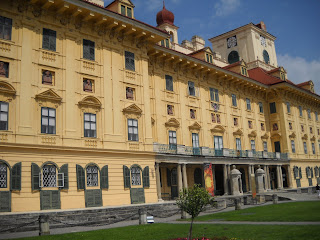
I think that Haydn Explosive was a little strange and flamboyant considering the subject matter. The artist of the exhibit says in a booklet that he was trying to reinstitute "the infectious joie de vivre of the eighteenth century [and explode] it back to life." Pop-art style carpets and psychedelic Haydn heads on wallpaper surrounded the famous photographs, paintings and autographs throughout the exhibit. In the second room of the exhibit there was a ceiling projection that was meant to show the influence of Haydn in Europe and London. It really just confused me with its cockroaches, bright colors and doomsday-like finish. It is hard to explain without being there, but the projection for me was over dramatic.
A really cool thing that I did see at the exhibit was Haydn's autograph copy of God Save Emperor Francis (Gott erhalte Franz den Kaiser), which is the theme of the German national anthem. There were also numerous theater bills, "beginner" symphonies, and works that had notes crossed off and redrawn in by the famous composer. It was almost like being able to see what Haydn was thinking while he was composing.
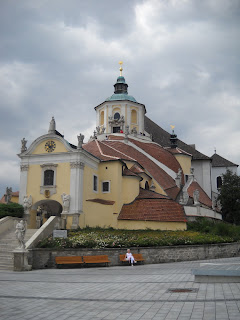
After the exhibit the group went to a really interesting shrine that laid out the Stations of the Cross. This is meant to depict the final hours of Jesus Christ and the Passion. Architecturally the building was interesting because you entered at the bottom and walked up stairs in a way that was meant to mirror Jesus’ final steps, or ascension into Heaven. At the top of the Kalvarienberg und Wallfahrtskapelle you walk out into the open air and get an amazing view of the Austrian countryside. Below are pictures of the shrine and Veronica wiping the face of Jesus.

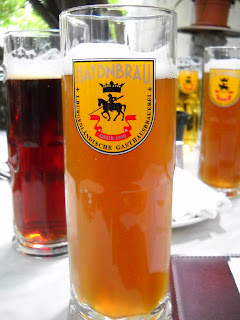
After our excursion there was only one more thing that we could do, and that is drink beer! A small group of us went to a microbrewery, which is an aspect of the trip that I was really looking forward to trying. I wanted to compare the Belgian ales we brew at the restaurant I work at in Sacramento with the "real deal" in Austria and Germany. I am really happy to say that they are quite similar in body and flavor! I made friends with a server in the restaurant after telling him I worked at a brewery and he proceeded to give me tasters of every beer in the restaurant. That is the perk of working in the business!
August 9th, 2009
Wien is a city rich in culture but also full of military conquests and defeats. The wars with the Ottomans, France, Prussia and allied powers during WWI and WWII have left lasting effects on Wien's history and its people; not to mention the occupation of Austria and Wien by Nazi Germany as well as Russia.

Today I learned about the history of the Viennese at the Heeresgeschichtliches Museum (Museum of Military History), the first museum to be built within the city boundaries. It is located right off of the Ringstraße in the Wien Arsenel, which was built between 1848-1856 and replaced the old city fortification. The museum was finished in 1891 and was used as barracks and armory during WWI. The museum itself is quite beautiful to walk into. The room you enter into today is known as "The Hall of Strategists" and has high vaulted ceilings with marble statues. Unfortunately this is the only museum that I have been too in Wien where I have to pay a fee to take pictures. I feel like this is rather ridiculous, although one sticker (that shows you've paid the three euro) will suffice for the entire group. Good thing Jordan is rich and didn't mind fronting the money!

The point of this visit was to focus on the Ottoman Empire and the portrayal of Turks and Christians during the Thirty Years War, although I did tour the entire museum. Class lecture and handouts from the Heeresgeschichtliches Museum revealed that European history in the 17th century was torn between the conflicts of Christianity vs. Protestantism and the Ottoman threat upon Wien and the Habsburg Empire from the East. The Thirty-Years War was initially fought as a war against Christianity and Protestantism, although it was as much about the Bourbon and Habsburg rivalry for power politics in Europe. The Turks became involved in the war when the Protestant Hungarian Prince of Transylvania, Bethlen Gabor, requested aid against the Habsburgs through Ottoman Sultan Osman II. The Ottomans gave 60,000 cavalry to Frederick V and said they would invade Poland with 400,000 troops if an annual tribute was paid to the Sultan. This set off the Polish–Ottoman War of 1620-21 where the Ottomans defeated the Poles who were supporting the Habsburgs in the Thirty Years' War. I wont go into the logistics of the fighting in this blog, but it was the Thirty Years War that marked the last religious war between Protestants and Catholics in Europe as well as the end of the Reformation. It was after the mess that Prince Eugene of Savoy became known as the defeater of the Turks during the second seize of Wien in 1683.
There is a lot of great artwork in the Heeresgeschichtliches Museum that portrays the differences between Turks and Christians. The museum is biased because its represents the military history of the Viennese in Wien. I am sure if I walked around in a Turkish museum than the portraits and art would be heavily in their favor. The Turks are shown as a noticeably foreign and menacing group. They are evil and corrupt in that they want to destroy the Holy Roman Empire. In comparison the Christians are seen as white, noble and virtuous. They are the saviors of the empire and it's last defense against the barbarians. History is always portrayed in a positive light for the victors, and in the case of the Christians in the artifacts at the Heeresgeschichtliches Museum that is no exception. Below is a sculpture of Albrecht Wenzel Eusebius von Wallenstein, the supreme commander of the armies of the Habsburg Monarchy and one of the major figures of the Thirty Years' War. Below him is a portrait of a Turkish man. Notice a difference?


There were some other really interesting artifacts that I enjoyed seeing while at the museum. The uniform and car that Archduke Francis Ferdinand was on display, as well as pictures of the Serbian nationalists who conspired in his murder. His death is what made the Austria-Hungarian Empire declare war on Serbia and form the split in politics that led to the outbreak of WWI.


There was also a great deal of Nazi regalia, which I found interesting because I had never seen it up close. After talking with students I found that most found this to be the "more interesting" part of the tour because they felt it was something that directly affected people in their families (i.e.: grandparents, great grandparents). I don't feel this way because it was Wien's past history that led to its involvement with the Nazi's and occupation during The Great War. You have to look at the past to understand the future.

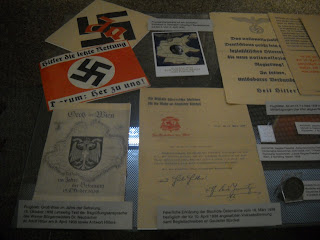
There was a great deal of interpretive art within the exhibit that dealt with the horrendous actions of the Nazi's throughout Austria and the rest of Europe. I think this added an element of emotion to the museum that would not have been felt otherwise. Themes of cannibalism, castration and death were repeatedly used in this exhibit.


More to come soon...
August 7th, 2009
Considering that a lot of the day was spent by students trying to "feel better" after their trip to abbey, we as a whole felt that today would be the best to compare the greasy fast food in America with that in Wien. On the way to the catacombs in the morning I went with some of the girls to McDonald's, which in America has a reputation for being fast, quick and greasy. Fast food is very different in Europe than in the United States because when you order the food you stay in line (or at the counter) until it is brought to you. The food options are pretty much the same world over except for minor differences that lean to the national cuisine. At McDonald's I ate an Egg McMuffin and Fanta, which tasted exactly the same as in America EXCEPT for the Fanta. European Fanta is AMAZING! It tastes like fruit juice with fizzy water rather than high fructose corn syrup and orange flavoring. As you can see, I am a big fan.
Something that I thought was interesting about the McDonald's I ate at in Wien was the decor. There were hard wood floor, comfortable benches and tables to sit at, artwork on the walls and big screen televisions playing the music "hits" (aka a lot of Michael Jackson). This is a complete contrast to stores in the United States with their unwelcoming plastic neon red and yellow booths and swivel chairs. I felt like I could spend the day inside the McDonald's in Wien to sit and talk with friends, while locally I can't wait to get out of the door. For a lack of a better word, the McDonald's in Wien felt classy.
This changed a little bit, however, when Jan and I decided to try out the menu at Burger King. The Burger King was clearly more westernized, with a motif of football players and scrimmages. The food was once again the same as in the states, but it didn't feel as "classy" as the McDonald's that I had ate at earlier in the day. (I can't believe I've used the word classy and McDonald's in the same sentence twice in this blog!) I feel like this could also have to do with the area that the restaurants are located, since the McDonald's was in a "rich area" of town in Stephansplatz while Burger King was in a more urbanized area of Simmering. There was a lot more begging for scraps and food and drink at Simmering, which reminded me of home but at the same time made me feel somewhat uncomfortable. Although I see poverty nearly everyday in downtown Sacramento it is still difficult to see a child wondering in the trash at a fast food restaurant while his mother is looking in to see his progress.


