skip to main |
skip to sidebar
August 11-13, 2009
The Alps have been absolutely amazing over the last couple of days. Today has been one of the most relaxing days so far and also one of the most enlightening.

After a breakfast of ham, cheese and coffee I heard rumors of fellow students wanting to hike to Heukuppe, the summit of the Rax Mountain, which we are staying on. (I am now kicking my butt that I didn’t grab the extra jacket that my mom tried to give to me before I left!) I wanted to get up today with the small group that left to watch the sunrise at Ottohaus, a small bed and breakfast close to where we are staying, but I soon realized that I did not bring proper dress for the trip. This is unfortunate not only because I can’t go with the group, but also because it means I need to better take the advice of my mother.
At 9:45 AM I took off with Melodie, Natalie and Jan for a hike towards Ottohaus to see what we could find. The Austrian greenery is gorgeous!, with purple, yellow, white and orange flowers covering the surrounding hills. It was nice to be out of the busy city life and back into fresh air and a sense of freedom. We stopped at a few alters along the way to Ottohaus and Jan said that there are still people that will make pilgrimages to the sacred sites. The girls and I decided to "put on our hiking boots" and climb the difficult way up to Jakobskogel, a giant cross that overlooks Austrian valley. There are a lot of these crosses that can be seen from various mountaintops throughout the Alps and they date back to a time when Christianity reverted to nature and to marveling at the wondrous things that God can create. I imagine myself on the hike making my own pilgrimage, although I'm not quite sure what the end goal is supposed to be. It feels like I am at the top of the world on that mountain.

After we climbed back to Ottohaus and I had an AMAZING lunch of chocolate and a radler beer (great hiking nourishment!) the group hiked into an alpine garden towards a rock face that had been cut open manually. There was another cross that I had wanted to hike to but it started raining and I didn't want to fall of the rock face. The rain came and went the entire day, it couldn't really make up its mind whether to rain or be sunny. Jan and I took that chance that it would stay sunny (and it did!) and we went hiking together further up the mountain.

This time is probably what I enjoyed the most because we could relax at our own pace and talk about all sorts of different things. Jan was in many ways my saving grace on the trip because I feel like I related to her on more levels than some students who just wanted to party all the time. She is working on her PhD so it was nice to be able to "pick her brain" about not only school but life in general. The further up the mountain we hiked it seemed like the prettier the scenery became. Before we knew it we reached a sign that said "Ottohaus 1hr", and it only seemed like we had been walking for 20 minutes. By the time we got home it was already 5PM, so we had been hiking for roughly seven hours!

I think that is part of the point that Kathy was trying to make by brining us to the Alps. She was showing us how Austrians spend their free time away from the city and in nature. Many of the people who live in Vienna live in apartment buildings and complexes, so getting away to nature is important. There was a plethora of age groups and skill levels hiking in the mountains and in many ways I wish that Americans could be more in touch with nature and fitness. I would love to go back to the Alps during the winter and do some snow skiing. Apparently Jan trained to be a ski instructor in Switzerland, so maybe I can take some cues from her!
August 11th, 2009
The German word of the day for Aug. 10 was Autobhan, which translated into freeway.
We are on the way to the Austrian Alps right now, but not without making a stop first in Einstadt (aka Haydn country). Haydn Explosive, an interpretive art exhibit about the famous composer and his patrons, was being held at the Schloss Esterházy. The House of Esterházy was a noble Hungarian family that rose to accord in Austria during the 1600s. They were great patrons of Haydn and financed many of his musical works. Patronage was an important aspect of art culture because it was one of the only ways to get exposure for an artist. It is difficult for people to understand, but some of the greatest artists the world ever knew did their art based on their patrons specifications and not their own artistic genius. Below is Schloss Esterházy.
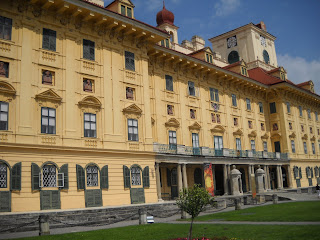
I think that Haydn Explosive was a little strange and flamboyant considering the subject matter. The artist of the exhibit says in a booklet that he was trying to reinstitute "the infectious joie de vivre of the eighteenth century [and explode] it back to life." Pop-art style carpets and psychedelic Haydn heads on wallpaper surrounded the famous photographs, paintings and autographs throughout the exhibit. In the second room of the exhibit there was a ceiling projection that was meant to show the influence of Haydn in Europe and London. It really just confused me with its cockroaches, bright colors and doomsday-like finish. It is hard to explain without being there, but the projection for me was over dramatic.
A really cool thing that I did see at the exhibit was Haydn's autograph copy of God Save Emperor Francis (Gott erhalte Franz den Kaiser), which is the theme of the German national anthem. There were also numerous theater bills, "beginner" symphonies, and works that had notes crossed off and redrawn in by the famous composer. It was almost like being able to see what Haydn was thinking while he was composing.
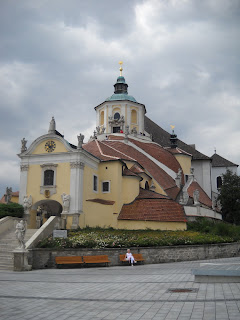
After the exhibit the group went to a really interesting shrine that laid out the Stations of the Cross. This is meant to depict the final hours of Jesus Christ and the Passion. Architecturally the building was interesting because you entered at the bottom and walked up stairs in a way that was meant to mirror Jesus’ final steps, or ascension into Heaven. At the top of the Kalvarienberg und Wallfahrtskapelle you walk out into the open air and get an amazing view of the Austrian countryside. Below are pictures of the shrine and Veronica wiping the face of Jesus.

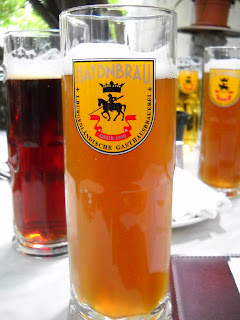
After our excursion there was only one more thing that we could do, and that is drink beer! A small group of us went to a microbrewery, which is an aspect of the trip that I was really looking forward to trying. I wanted to compare the Belgian ales we brew at the restaurant I work at in Sacramento with the "real deal" in Austria and Germany. I am really happy to say that they are quite similar in body and flavor! I made friends with a server in the restaurant after telling him I worked at a brewery and he proceeded to give me tasters of every beer in the restaurant. That is the perk of working in the business!
August 9th, 2009
Wien is a city rich in culture but also full of military conquests and defeats. The wars with the Ottomans, France, Prussia and allied powers during WWI and WWII have left lasting effects on Wien's history and its people; not to mention the occupation of Austria and Wien by Nazi Germany as well as Russia.

Today I learned about the history of the Viennese at the Heeresgeschichtliches Museum (Museum of Military History), the first museum to be built within the city boundaries. It is located right off of the Ringstraße in the Wien Arsenel, which was built between 1848-1856 and replaced the old city fortification. The museum was finished in 1891 and was used as barracks and armory during WWI. The museum itself is quite beautiful to walk into. The room you enter into today is known as "The Hall of Strategists" and has high vaulted ceilings with marble statues. Unfortunately this is the only museum that I have been too in Wien where I have to pay a fee to take pictures. I feel like this is rather ridiculous, although one sticker (that shows you've paid the three euro) will suffice for the entire group. Good thing Jordan is rich and didn't mind fronting the money!

The point of this visit was to focus on the Ottoman Empire and the portrayal of Turks and Christians during the Thirty Years War, although I did tour the entire museum. Class lecture and handouts from the Heeresgeschichtliches Museum revealed that European history in the 17th century was torn between the conflicts of Christianity vs. Protestantism and the Ottoman threat upon Wien and the Habsburg Empire from the East. The Thirty-Years War was initially fought as a war against Christianity and Protestantism, although it was as much about the Bourbon and Habsburg rivalry for power politics in Europe. The Turks became involved in the war when the Protestant Hungarian Prince of Transylvania, Bethlen Gabor, requested aid against the Habsburgs through Ottoman Sultan Osman II. The Ottomans gave 60,000 cavalry to Frederick V and said they would invade Poland with 400,000 troops if an annual tribute was paid to the Sultan. This set off the Polish–Ottoman War of 1620-21 where the Ottomans defeated the Poles who were supporting the Habsburgs in the Thirty Years' War. I wont go into the logistics of the fighting in this blog, but it was the Thirty Years War that marked the last religious war between Protestants and Catholics in Europe as well as the end of the Reformation. It was after the mess that Prince Eugene of Savoy became known as the defeater of the Turks during the second seize of Wien in 1683.
There is a lot of great artwork in the Heeresgeschichtliches Museum that portrays the differences between Turks and Christians. The museum is biased because its represents the military history of the Viennese in Wien. I am sure if I walked around in a Turkish museum than the portraits and art would be heavily in their favor. The Turks are shown as a noticeably foreign and menacing group. They are evil and corrupt in that they want to destroy the Holy Roman Empire. In comparison the Christians are seen as white, noble and virtuous. They are the saviors of the empire and it's last defense against the barbarians. History is always portrayed in a positive light for the victors, and in the case of the Christians in the artifacts at the Heeresgeschichtliches Museum that is no exception. Below is a sculpture of Albrecht Wenzel Eusebius von Wallenstein, the supreme commander of the armies of the Habsburg Monarchy and one of the major figures of the Thirty Years' War. Below him is a portrait of a Turkish man. Notice a difference?


There were some other really interesting artifacts that I enjoyed seeing while at the museum. The uniform and car that Archduke Francis Ferdinand was on display, as well as pictures of the Serbian nationalists who conspired in his murder. His death is what made the Austria-Hungarian Empire declare war on Serbia and form the split in politics that led to the outbreak of WWI.


There was also a great deal of Nazi regalia, which I found interesting because I had never seen it up close. After talking with students I found that most found this to be the "more interesting" part of the tour because they felt it was something that directly affected people in their families (i.e.: grandparents, great grandparents). I don't feel this way because it was Wien's past history that led to its involvement with the Nazi's and occupation during The Great War. You have to look at the past to understand the future.

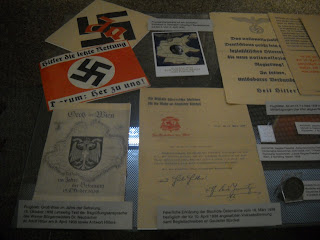
There was a great deal of interpretive art within the exhibit that dealt with the horrendous actions of the Nazi's throughout Austria and the rest of Europe. I think this added an element of emotion to the museum that would not have been felt otherwise. Themes of cannibalism, castration and death were repeatedly used in this exhibit.


More to come soon...
August 7th, 2009
Considering that a lot of the day was spent by students trying to "feel better" after their trip to abbey, we as a whole felt that today would be the best to compare the greasy fast food in America with that in Wien. On the way to the catacombs in the morning I went with some of the girls to McDonald's, which in America has a reputation for being fast, quick and greasy. Fast food is very different in Europe than in the United States because when you order the food you stay in line (or at the counter) until it is brought to you. The food options are pretty much the same world over except for minor differences that lean to the national cuisine. At McDonald's I ate an Egg McMuffin and Fanta, which tasted exactly the same as in America EXCEPT for the Fanta. European Fanta is AMAZING! It tastes like fruit juice with fizzy water rather than high fructose corn syrup and orange flavoring. As you can see, I am a big fan.
Something that I thought was interesting about the McDonald's I ate at in Wien was the decor. There were hard wood floor, comfortable benches and tables to sit at, artwork on the walls and big screen televisions playing the music "hits" (aka a lot of Michael Jackson). This is a complete contrast to stores in the United States with their unwelcoming plastic neon red and yellow booths and swivel chairs. I felt like I could spend the day inside the McDonald's in Wien to sit and talk with friends, while locally I can't wait to get out of the door. For a lack of a better word, the McDonald's in Wien felt classy.
This changed a little bit, however, when Jan and I decided to try out the menu at Burger King. The Burger King was clearly more westernized, with a motif of football players and scrimmages. The food was once again the same as in the states, but it didn't feel as "classy" as the McDonald's that I had ate at earlier in the day. (I can't believe I've used the word classy and McDonald's in the same sentence twice in this blog!) I feel like this could also have to do with the area that the restaurants are located, since the McDonald's was in a "rich area" of town in Stephansplatz while Burger King was in a more urbanized area of Simmering. There was a lot more begging for scraps and food and drink at Simmering, which reminded me of home but at the same time made me feel somewhat uncomfortable. Although I see poverty nearly everyday in downtown Sacramento it is still difficult to see a child wondering in the trash at a fast food restaurant while his mother is looking in to see his progress.
August 8th, 2009
Today I decided with a group of students to rent bikes and ride along the Danube. This is a trip that Kathy (our instructor) always higly recommended in class and stressed was "relaxing and a good way to get to know the city." It is always difficult, however, to coordinate a large group of individuals with different ideas of where they want to ride as well as different biking levels. All of the Davis students, of course, assumed that the group as a whole would be expert bicyclists becaue the biking culture in Davis is so prevalant. At one point there was actually talk of riding to Melk, which was quickly shot down after our hodge podge of riders and skill level were reevaluated.

The trip did work out, however, as we ended up biking on an island that was created in the middle of the Danube by dredging the river. The river life on the Danube reminded me of what life is like on the American River in Sacramento, just with a lot more nudity. Nudity is not something that bothers me, however, and I probably would have gone topless had it not been for the group of boys that I was with and their amount of maturity on the subject. There are numerous restaurants and pubs along the river that a biker can stop of for nourishment, and I liked the amount of kids water attractions (slides) that were set up at various intervals along the water front.


The Danube is very beautiful but it is not blue, no matter what the song says. I swam across a stretch of the river with Anthony, another student, and it was refreshing to bond with someone who came on the trip for the same reason as me. (SCHOOL!) We had a really good conversation about our lives back in Sacramento and Davis, significant others and what we were both hoping to take out of the summer abroad program. After having such good conversation it was difficult to go back to the group because there were individuals who seemed to forget that just because they don't understand German does not mean Austrians don't understand English. One of the major difficulties that I had throughout the entire trip was staying away from the stereotype of a "typical American", which I found myself in a lot when hanging out with the group in its entirity.
Anthony, another student and myself rode our bikes back into the city (which was very calming) to the bicycle shop that was across the street from the famous Ferris Wheel. I took some extra initiative and got to know the locals at the shop, who were young adults about my age. They invited the three of us out to a techno club, but I have never been one for clubbing. It was cool to get to know people though and realize that even though I did not speak the language I could get along in the city just fine.
August 7th, 2009
The German word of the day is Beantwarten, which translates into "too answer".
Class was canceled today, which might have something to do with the amount of wine consumed at the Heuriger, but I won't speculate.
Due to this unforseen "break" I have decided with a group of students to go back to Stephansdom and visit the catacombs. Being in a Catholic country has confronted me with a death culture unlike I have have ever expereinced before. I feel that Americans don't talk about death or confront their fears on the subject, while in Vienna there are countless sites and very extravagant burial grounds that are suposed to lead to the after life. The Katakomben at Stephansdom are no exception. In 1732 a plague epedemic was taking hold in Vienna and Emperor Karl VI closed the cemetary because of the overflow of dead bodies. Over 11,000 people in the 18th century were "burried" in the catacombs and "Duke's Crypt", which holds remains of the Hapsburgs. It is hard to understand the amount of death that went on in the city, but a giant hole was placed at the center of Stephansplatz that led into the catacombs so that bodies could be dumped and disposed of properly. By having the catacombes under the church it made the Catholic Viennese less fearful of death because their bones would be in a sacred place. It was strange to see the amount of bones and skulls that were stacked upon each other and try to comprhend the amount of death that the plague brought to Europe.
 After the trip I went on a tour of the Kunsthistorisches museum, one of the most important museums built in Euope in the 19th century. It was built along the Ringstraße, the site where the old wall of Vienna used to stand. It is built in the style of the Italian Renaissance and has collections that date back to ancient antiquity. The artists that are represented in this museum are extensive and include: Jan van Eyuck, Albrecht Dürer, Caravaggio, Raphael, Pieter Brueghel the Elder, and many more. I was able to see Raphael's Madonna of the Meadow, Velázquez's Infanta Margarita Teresa in a Blue Dress and Pieter Bruegel the Elder's The Fight Between Carnival and Lent. It is difficult to describe what it is like to see these works of art in person after studying them in Davis, CA. It almost seems like you are in a different world, and in many ways when looking at these paintings you are. The class lecture about art during the Reformation and Counter Reformation was also clearly visible in the Kunsthistorisches. Two baroque artists that were compared side-by-side during the museum tour were Rebrandt and Peter Paul Rubens; both prolific artists in their styles of art. Rembrandt was a Dutch painter and etcher who focused on portraiture, landscape and narrative painting. His paintings are characteristically "real-life" and more subdue, representing the Reformation and its move away from the grandiose excess of the church. Below are Rebrandt's Self-Portrait as well as Portrait of Titus, reading.


Rubens, on the other hand, is a Flemish painter who gravitated towards "movement, color and sensuality", with art work that clearly shows a move towards mythological and allegorical subject. You can clearly see the difference in styles between the two artists who are simualating the styles popular with the Reformation and Counter Reformation. Below are Rubens' The Head of Medusa and Cymon and Iphigenia.


I think one of the best paintings that captured the struggle between the Reformation and Counter Reformation is Pieter Bruegel the Elder's The Fight Between Carnival and Lent. It represents the peasant in a struggle between self-indulgence and excess while at the same time becoming mixed with self-denial, penitence and being one with the church. Bruegel lived during the Protestant Reformation and was (I believe) painting the split that he saw within the religious world.

**All of the images on this blog have been grabbed from Google Images because my camera sucks.
August 6th, 2009
Today has been a day of elation, squashed stereotypes and minor debauchery. These are not typical emotions that you would equate or use to describe a visit to a 900-year-old winery and stift, but Klosterneuburg Monastery (too me!) is not a normal church! The tour itself was split into two parts beginning with the winery and its history followed by another tour (by an Augustinian Canon!) of the church and its world famous art collection. Anytime you mix wine with history and art you are bound to have a good time!
WINERY
According to the tour guide of the winery, Klosterneuburg Monastery helped to develop a rich tradition of viticulture and economic prosperity in the region. The winery is one of the oldest wine estates in Austria on 108 hectares, which is the equivalent to 108,000 acres. The winery has four different lands that it cultivates on, which includes Klosterneuburg, Vienna, Gumpoldskirchen and Tattendor. It was very interesting traveling underground into the baroque cellar because I found out that it was forged by the Romans in the 1st century B.C., which I found amazing. The ventilation system dates back to that era as well and is surprisingly simple in how it was planned out. The Danube River, which runs along the monastery, is separated from the wine cellar with meter-thick walls that keeps the interior quite cool. The cellar is also 36 meters below the earth, which helps control the temperature.

One of the areas that I found intriguing was the production facility of the wines, which was split in a large room between whites and reds. I think that I took a liking to this part of the tour because it reminded me of the brewery that I work at in Sacramento and I like to see the work that goes behind the final outcome. One major difference that took students aback was the use of black mold in the cellar area to gage if the temperature was correct. I know that in California black mold is seen as a dangerous and sometimes lethal problem is housing developments, so it was comical to see it being used in a positive way at Klosternueburg.

THE “SACRED TOUR”
As I said before, this day squashed stereotypes for me that I previously didn’t even know existed. Not being raised within a certain denomination I was a little uneasy about having a tour led by a monk, or Augustinian Canon, because I didn’t really know how to act around him. The fact that he was going to be our guide was described as a real honor, which of course it was, but canons in general were described prior to the trip as staying away from tourists and somewhat recluse. Father Clemens, on the other hand, was extremely funny and insightful on the tour of the church and its treasures. He is a New Yorker at heart, and I think he took our tour group because we were young English speaking students and he wanted to get a perspective on us. (One of the first things he said to us was that we were “from the wrong coast”.) I think he was pleased when he found out that most of the students on the trip were history majors because he could go into detail about the facts behind the abbey.
Saint Leopold, the patron saint of Austria, founded Stift Klosterneuburg in 1114. In 1106 Leopold III married the daughter is German Emperor Heinrich IV, named Agnes. Legend says that after the wedding a gust of wind blew away her bridal veil and Leopold said that wherever the veil was found he would build a monastery. Nine years later the veil was found clean and intact on an elder brush, and this is today the site of the Abbey Church of Klosterneuburg. Below is a gold engraving of the legend.

In 1133 Leopold III turned over the monastery that he had founded to the Augustinian Canons. According to Father Clemens the Canons today preach the word of St. Augustine, “the founder of an order and bishop of Hippo in North Africa.” Communal life in the church is said to be connected to the followers of God through work in the parish.

In a semi-related note, I thought it was very interesting that the complex was to be used as an Austrian Escorial, much like the Hapsburg Escorial in Madrid. Emperor Charles VI, the father of Maria Theresa, had extremely ambitious plans to make the Escorial in the Baroque taste that was so fashionable at the time. When he died, however, construction ended. It is strange to walk through the place where the gift shop is and see giant unfinished sculptures coming out of the wall and realizing the plans that the emperor had for the place. Until recently the gift shop room was actually used to store boxes for the wine production. Below is a picture of what the Escorial should have looked like if completes as well as an unfinished statue on the wall and ceiling.

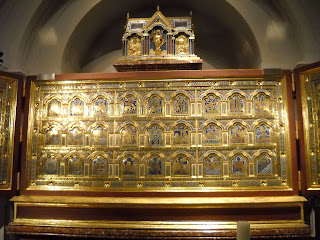
 There are many aspects of the tour that to me stood out as once-in-a-lifetime opportunities. I almost cried when I got to see the Verdun Alter made by Nicholas of Verdun, one of the most famous goldsmiths and enamellists during the Middle Ages. The Alter is enclosed within a large gate and is a triptych of 51 enamel panels that shows “the epochs of salvific history.” Father Clemens actually opened the gate and let us inside, so I was inches away from the famous work of art. I made a mental note inside the gate to call my renaissance art history instructor and ask if she was ever had the ability to do something that cool! I was also able to see the seven-armed candelabra up close, which I had only seen in my art history books.
 Another amazing experience that Father Clemens allowed was for the students to go up next to the high alter and sit in the choir seats. The church was absolutely beautiful in the Baroque greens and gold, and it is easy to see how someone could get swept up in its grandeur. Every inch of that church (on the walls and ceilings) was telling a story and I have never been in or seen a church outside of Europe that was so beautiful.

 THE AFTER PARTY
After the tour Father Clemens joined as at a Heuriger, which is a wine-garden restaurant that features the wine of that particular year. I tried Blutwurst, which is a German sausage made out of pork rind, pork blood and spices. It sounds gross, but it’s actually delicious! Father Clemens made sure that the wine glasses were never empty, and we went through 26 bottles of Grüner Veltliner. That is where the debauchery went down, although I won’t go into details about that! ;)


